
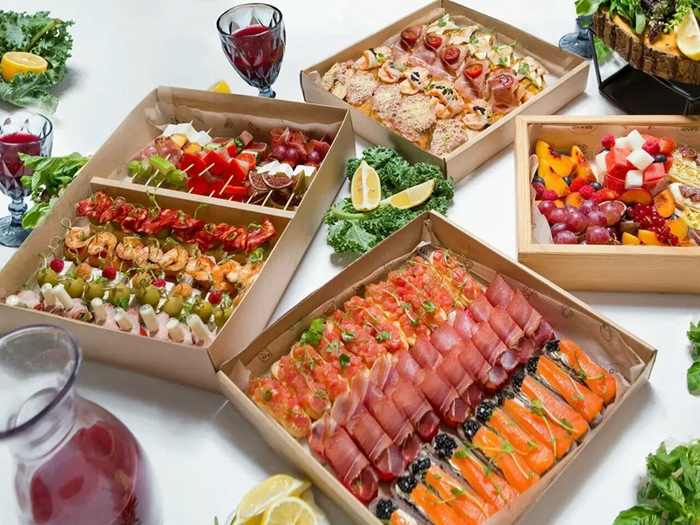
Catering food is a well-thought-out menu designed to serve guests outside of a brick-and-mortar restaurant: at a corporate event, wedding, presentation, off-site buffet, or family celebration.
It’s important that dishes are easy to transport, retain their flavor and appearance, and are convenient to serve and eat.
Catering cuisine combines gastronomic quality with technological efficiency: portion sizes, shelf life, logistics, and service speed are calculated in advance. Well-organized catering at an event relieves the burden on the customer, while guests enjoy variety and consistent quality in every serving.
Advantages of Catering
- Menu flexibility: customize the format to suit your event – buffet appetizers, banquets, coffee breaks, BBQ, hot food stations.
- Budget manageability: clear per-guest pricing, control over the quantity and composition of dishes.
- Speed of service: pre-prepared elements speed up service, especially in a buffet format.
- Consistent quality: recipes are standardized, and processes are repeatable from batch to batch.
- Presentation aesthetics: portioned solutions, neat decor, a unified serving concept.
- Diet and preferences can be accommodated: vegetarian, lactose-free, gluten-free, halal, and other options are available.
For events with higher expectations for taste and personalization, personal chef, who adapts dishes to the evening’s theme and guest preferences, while maintaining the requirements of catering technology.
Why Off-Premise Catering Outperforms Restaurant Service
Off-premise catering removes the main constraint of the restaurant format – location. Guests remain in a convenient location, while the kitchen, service, and presentation “arrive” to the event venue: an office, a country house, a conference venue, or an outdoor area.
Catering offers greater control over the event scenario: timing, logistics, menu, and service pace. This is especially important when food must support the program (breaks, speeches, activities) and still look appropriate – from a business coffee break to a wedding reception.
- Flexibility in format and scale: buffets, banquets, barbecues, coffee breaks, station servings, tastings – tailored to the task and number of guests.
- Menu tailored to the audience: allergies, religious restrictions, vegetarian and children’s options, as well as seasonality and budget considerations are taken into account.
- Single responsibility: one team is responsible for preparation, delivery, arrangement, serving, and cleanup, reducing the risk of complications.
- Time savings for the organizer: no need to adjust to the restaurant’s schedule and seating; easier coordination of timing and number of servings.
- Serving and quality at the right time: dishes are assembled and brought to readiness, taking into account transportation and temperature conditions.
Results
Off-premises catering is superior to restaurant service in that it adapts to the location, scenario, and guests, rather than the other way around. Catering transforms food into a manageable part of the event: precise timing, the desired format, a personalized menu, and turnkey service – without the compromises associated with restaurant restrictions.