
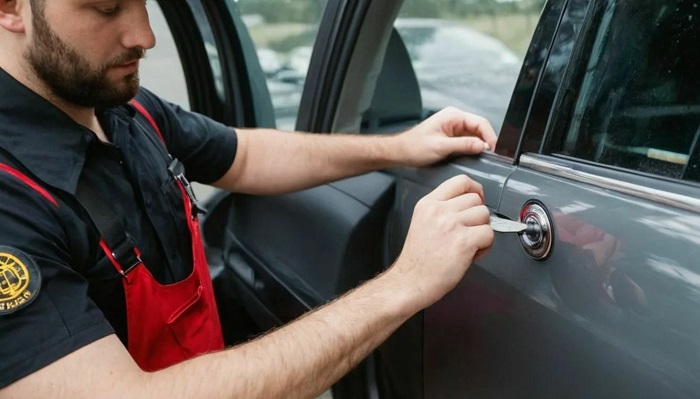
Vehicle unlocking refers to a set of procedures used to open doors or the trunk, or to gain access to the interior, in situations such as lost keys, a broken lock, a dead battery, or the activation of security/locking mechanisms. It is important to distinguish between legitimate assistance provided to an owner and illegal entry: in the former case, the objective is to restore access without causing damage, contingent upon verification of ownership.
Improper attempts to open a vehicle using improvised tools often result in the deformation of the door frame, damage to weather stripping, scratches to the paintwork, or breakage of the lock cylinder. Below are practical guidelines and tips to help ensure that the process is carried out safely, legally, and with minimal risk.
Guidelines for Safe and Legal Vehicle Unlocking
The primary rule is to act only when there is a legitimate basis for doing so, and to always aim to gain access without causing any damage.
Using questionable methods can lead not only to the need for repairs but also to legal consequences—especially if you are working on a vehicle that does not belong to you or if you cannot provide proof of your right to access it.
Legality and Proof of Authorization
- Only attempt to open a vehicle that belongs to you or one for which you have a legal right of access.
- When contacting a professional, have your documentation ready: vehicle registration, a power of attorney, a rental or car-sharing agreement, or an authorization document from your employer.
- If the vehicle belongs to someone else (e.g., a company car or a rental), coordinate with the owner or the company and ensure their consent is documented.
What to Avoid to Prevent Vehicle Damage
- Do not attempt to pry open a door with a screwdriver or a crowbar; this can easily damage the door edge, the weather stripping, and the vehicle’s structural alignment.
- Do not break a window as a “quick fix”—it is almost always more expensive and dangerous, and the glass shards can damage the interior.
- Do not pour harsh chemicals into the lock; some substances can destroy plastic components or wash away lubricants, accelerating wear and tear.
- Do not follow unreliable, generic instructions for modern vehicles; their complex electronic systems and security interlocks can cause further issues, potentially preventing the car from starting later.
The Proper Approach: A Step-by-Step Guide
-
- Assess the urgency: If a child or an animal is trapped inside, or if there is a risk of extreme heat or cold, prioritize safety—call emergency services and act according to the situation.
- Choose the least invasive solution: Use a spare key, contact the dealership, or reach out to an authorized service provider or a professional locksmith.
- Document the vehicle’s condition: Take a few photos of the doors and windows before starting; this can be helpful in the event of any disputes.
- Ask for an explanation of the method: A qualified professional will explain their approach beforehand, …where and how the work will be performed, and what risks may still exist.
- Check the outcome: once the vehicle is opened, ensure that the windows, seals, and locks are all functioning correctly.
Useful tips for the future
-
-
- Make a spare key and keep it separate from your main set.
- Keep an eye on your key fob battery; replace it proactively rather than waiting until it dies completely.
- Lubricate locks and seals using appropriate, season-specific products—especially before the onset of freezing weather.
- Keep a record of your vehicle identification number (VIN) and other car details in a safe place; this helps expedite assistance from a dealership.
- Maintain the contact information for a reliable professional service and clarify their terms in advance; you can find more details about vehicle unlocking services on our https://lockdoc.ca.
-
In summary: a safe vehicle-unlocking process combines legal compliance, careful execution, and the use of non-destructive methods. The less you rely on “DIY” attempts or crude tools, the better your chances of gaining access to your vehicle without the need for repairs or incurring additional costs.
When and under what circumstances is it permissible to unlock a vehicle legally?
Whether or not unlocking a vehicle is legally permissible depends not on the act itself, but on the underlying circumstances: who is performing the unlocking, whose vehicle it is, the purpose behind the action, and the methods employed.
It is important to consider the owner’s rights, the rules regarding access to property, and the need for evidence that any actions taken are lawful.
To avoid potential claims, follow the principle of “minimal necessity”: only open the vehicle when absolutely required, avoid destructive methods unless strictly necessary, and—whenever possible—document the circumstances (e.g., by having witnesses present, taking photos or videos, keeping relevant paperwork, or contacting emergency services).
Legal Grounds and Safe Practices
Opening a vehicle is permissible in the following situations:
-
-
- You are the owner or an authorized user (such as a lessee or a driver with a valid power of attorney or contract), and the objective is to regain access due to lost keys or a vehicle lockout. It is advisable to have the vehicle’s registration documents and your own identification on hand.
- You have the explicit consent of the owner—ideally in writing, or otherwise verifiable via correspondence or a phone call—authorizing the opening of the vehicle and specifying who is permitted to perform the task.
- Emergency situations: immediate action is required to prevent harm to people or property (for example, if a child or another person is locked inside, an animal is in a dangerous environment, there is an imminent risk of fire, a leak, or an electrical short circuit, or the vehicle is obstructing rescue operations). In such cases, it is prudent to simultaneously contact emergency services.
- Actions taken by authorized personnel (such as police or emergency responders).emergency/evacuation services) acting within the scope of their authority and established procedures—for example, in situations involving a threat to life, safety concerns, investigative actions, or when access to a vehicle is required by official protocol.
-
To ensure your actions remain lawful, follow these practical guidelines:
-
-
- Verify your right to access: have vehicle registration documents, a rental/lease agreement, a power of attorney, correspondence with the owner, a call recording (where legally permissible), or the owner’s physical presence.
- Consider less intrusive alternatives: check for a spare key, or seek assistance from a dealership, insurance provider, or professional lockout service—ensuring that such assistance is properly documented.
- Avoid destructive methods unless absolutely necessary: breaking a window or damaging a lock or door is only justified in cases of genuine urgency (such as a threat to life or safety) or when no other options exist and the resulting damage is proportionate to the risk.
- Document the circumstances: take photos or videos before and after the event, identify witnesses, obtain a receipt or service report from the lockout professional, and keep a record of the time and reasons for the action (especially in emergencies).
- Never open someone else’s vehicle without consent—even if it is “just for a minute” or to “help a friend”—unless you have verified authorization; such actions can easily be classified as unlawful.
-
In summary: opening a vehicle is permissible without legal violation if you have the right to access it (as the owner or authorized user), have the owner’s explicit consent, are dealing with an emergency that requires immediate action, or if the opening is performed by authorized services. The more transparent the justification and the more careful the approach—minimizing damage while maximizing documentation—the lower the risk of legal claims or conflicts.